
Jim Wells Release Date Meanings
TDCJ uses several date fields that answer different questions. Projected Release Date is the Classification and Records Office estimate of when a currently incarcerated person may leave if parole does not happen sooner. Offense title, offense date, mandatory-supervision eligibility, good-conduct time, and Board action can affect it. Maximum Expiration represents sentence completion and may become the projected date when mandatory supervision is denied or unavailable.
Scheduled Release Date and Scheduled Release Location appear only after TDCJ has set the administrative event. Parole Eligibility Date and the next Board review date are milestones, not release promises. Actual release is the event recorded after physical custody ends. For a Jim Wells County jail detainee, the sheriff's release timestamp and destination are the key physical-custody fields.
| Field or event | What it means |
|---|---|
| Projected Release Date | TDCJ calculation for a current prisoner if parole does not occur sooner |
| Parole Eligibility Date | Earliest review milestone under applicable law, not a promise |
| Scheduled Release Date | Administratively set event after approval and processing |
| Maximum Expiration | Sentence completion date, sometimes used as the projection |
| Actual Release | Recorded end of physical custody with reason and destination |
Lookup Jim Wells Projected Release
Begin with custody type. The official Jim Wells County roster only addresses present county-jail custody. The TDCJ online search only contains people currently incarcerated in a TDCJ facility. Neither is a complete historical release archive. A person missing from both may be between systems, released, transferred elsewhere, or absent because of a data lag.
- Identify the person with name and date of birth plus a booking, SID, TDCJ, or cause number when available.
- Check the official Jim Wells jail page for its Current Jail Roster link. If present there, ask the jail whether the case is pretrial or sentenced.
- For a TDCJ prisoner, search by last name and first initial, TDCJ number, or SID number. Use date of birth to narrow name matches.
- Open the correct TDCJ detail and read projected release, maximum expiration, parole eligibility, offense, county of conviction, and any scheduled date or location.
- For a county sentence, obtain the judgment, jail-credit provisions, local good-time record, detainers, and sheriff calculation. Do not apply the TDCJ field to county time.
- If the person no longer appears online, email TDCJ for incarceration history and actual release or discharge information, or request the Jim Wells booking-and-release record.
The broader Jim Wells County release-record route helps distinguish community release from a transfer. Ask the sheriff for release date and time, release reason, destination, and hold disposition.
Note: TDCJ says its online data are updated on working days and are at least twenty-four hours old.
Jim Wells TDCJ Search Fields
The TDCJ Inmate Search accepts a name, TDCJ number, or SID number. A name search needs at least a last name and first initial. Date of birth helps separate people with similar names. The result must be opened and matched against conviction and sentence data before its dates are used.
| Search or result field | Use | Limit |
|---|---|---|
| Last name and first initial | Starts a name search | May return several matches |
| Date of birth | Narrows a name match | Should be paired with another identifier |
| TDCJ number | Targets the state custody record | Seven-digit number may be unknown |
| SID number | Targets the Texas identification record | Must be entered accurately |
| Projected date | Shows the current TDCJ calculation | Not guaranteed |
| Maximum expiration | Shows sentence completion as calculated | Not always the physical-release event |
The official TDCJ search image shows where the state route begins.
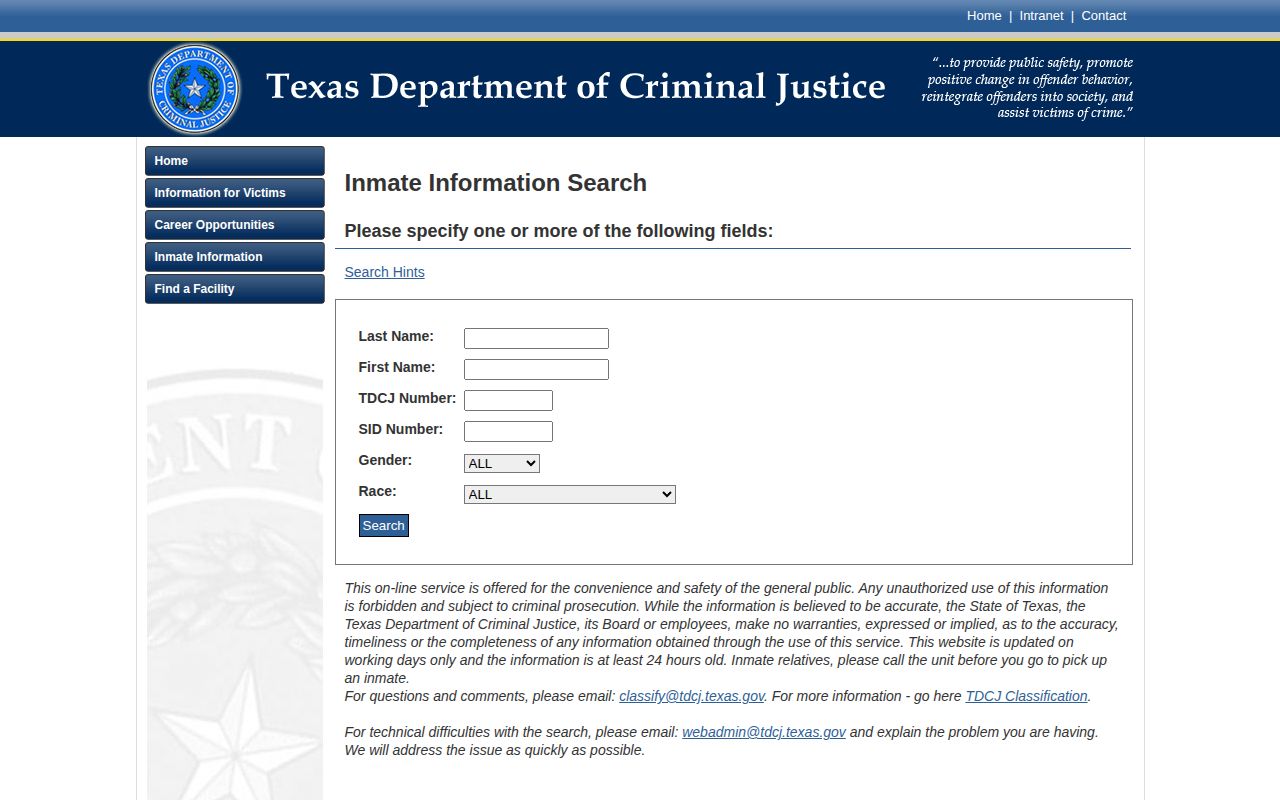
Use the person detail, not just the result list, and retain the identifiers needed for follow-up.
Jim Wells Release Date Alternatives
When the current-only TDCJ locator no longer returns a former prisoner, email TDCJ inmate information. Give the full name and seven-digit TDCJ number. If the number is unknown, provide the exact date of birth, or approximate age and county of conviction. Ask for incarceration history, actual physical-release date, release mechanism, and supervision-discharge date. The general email service is free and does not provide photographs or Social Security numbers.
The TDCJ definition page also explains that projected release assumes parole does not occur sooner. Its public wording is shown in the captured source.
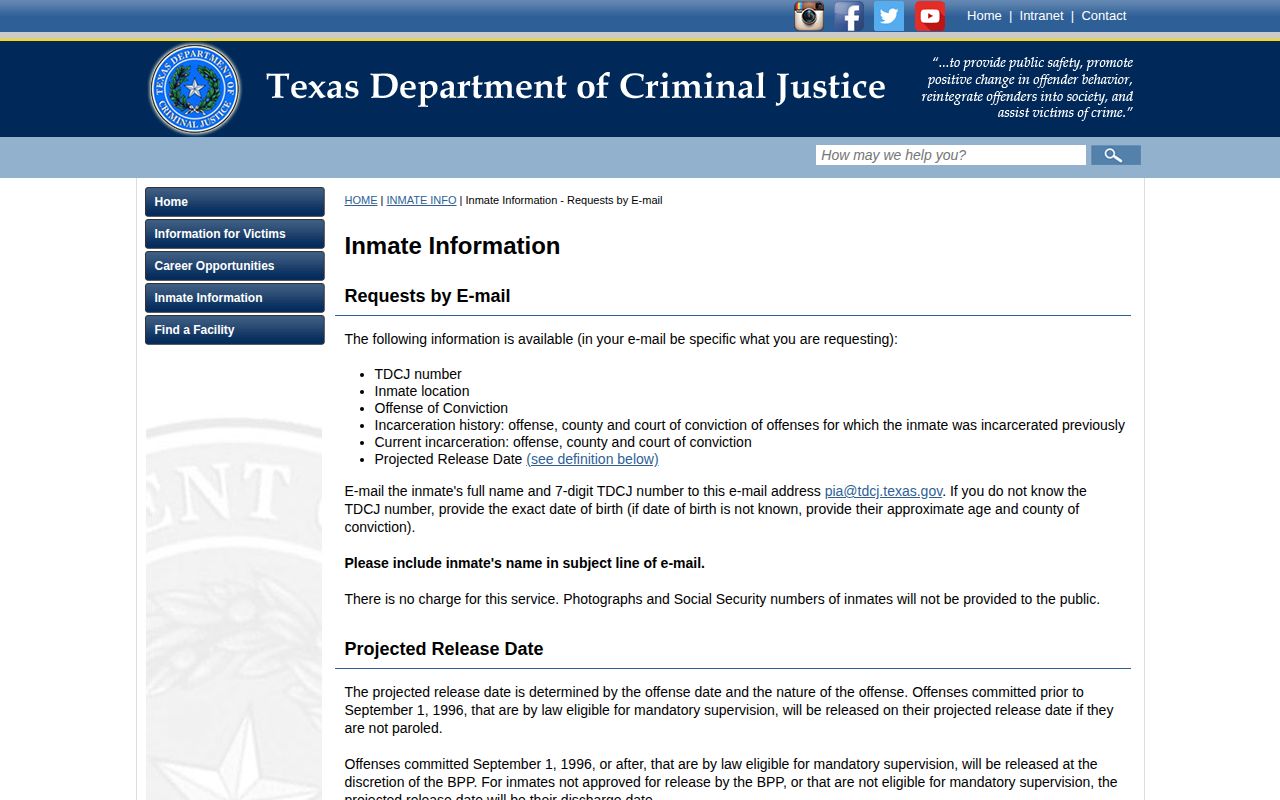
That definition helps prevent a projected field from being reported as a fixed promise.
For Jim Wells County Jail, call 361-668-0341 with the booking identifier and submit a focused public-information request if documentary proof is needed. Search the County Clerk for county-level criminal cases and the District Clerk for felonies. The judgment supplies sentence and jail-credit terms, while the sheriff record supplies the booking-out event.
Texas Good Time for Releases
Government Code section 498.003 states that good-conduct time affects eligibility for parole or mandatory supervision. It does not otherwise reduce the sentence, and it is a privilege rather than a right. Current classifications include twenty days per thirty days actually served for trusty or Class I status, ten per thirty for Class II, and none for Class III or while already released on supervision. Qualifying program credits may also apply within legal limits. Credits can be forfeited.
There is no general Texas rule that all state prisoners serve about eighty-five percent. For specified serious offenses, Government Code section 508.145(d) generally uses actual calendar time, without good-conduct time, equal to one-half of the sentence or thirty calendar years, whichever is less, ordinarily with a two-year minimum. The offense list, deadly-weapon findings, offense date, consecutive sentences, and special offense rules matter. A percentage shortcut can produce a false date.
Mandatory supervision adds another layer. For eligible offenses before September 1, 1996, TDCJ explains that flat time plus good time may produce the projected date if parole does not occur. For later eligible cases, BPP discretion applies under sections 508.147 and 508.149. A denial can reset the projection to maximum expiration. Later approval may move it earlier.
- Flat time
- Actual calendar time spent serving the sentence.
- Good-conduct time
- A classification-based credit affecting eligibility, not an automatic sentence reduction.
- Mandatory supervision
- A supervised-release route governed by eligibility exclusions and, for later cases, Board discretion.
- Detainer
- A request or hold from another authority that can change where the person goes.
Jim Wells County Good Time
County-jail calculations are separate from TDCJ rules. Texas Code of Criminal Procedure article 42.032, section 2 permits a sheriff to grant good-conduct commutation of up to one day for each day actually served when no sustained misconduct charge exists. The statute permits the credit; it does not require Jim Wells County to grant the maximum, and it does not show that every person qualifies.
A sound county calculation needs the signed judgment, court-awarded jail credit, the sheriff's local classification or award, any sustained misconduct, holds from other agencies, and final processing. No written Jim Wells policy was found that states its current good-time method or weekend-release practice. Ask the sheriff for the policy in force for that booking and for the actual calculation sheet or release authorization. Do not convert a county sentence with the state prison formula.
A pretrial detainee is different again. No sentence is being shortened. Release depends on bond being posted, a personal-bond decision, dismissal, acquittal, court order, or another legal event, subject to holds. A bond amount set in a docket does not prove it was posted.
Why Jim Wells Release Dates Change
A projected date is a live calculation. The date can move because the legal record, credit record, release decision, or receiving-custody facts change. The correct response is to record which field was viewed and when, then confirm closer to the event.
| Factor | Possible effect | Confirm with |
|---|---|---|
| Good-time class or forfeiture | Changes mandatory-supervision eligibility calculation | TDCJ Classification and Records |
| BPP approval or denial | Can advance release or reset projection toward maximum expiration | BPP status and vote record |
| Required program | Can delay an approved release until completion | TDCJ release processing |
| Warrant or detainer | Can delay community release or cause transfer | Releasing and receiving agencies |
| Court order or amended judgment | Can alter sentence credit or legal authority | Jim Wells clerk and signed order |
| Administrative audit | Can change a scheduled event | TDCJ release unit |
TDCJ Review and Release Processing coordinates parole and mandatory-supervision releases. After a release certificate reaches Classification and Records, one described audit and calculation workflow may take about fourteen to twenty-one business days. Some program-based releases take longer. That period is not a promise for every case.
Note: A transfer date ends one custodian's hold but does not establish release to the community.
Confirm Jim Wells Actual Release
Check the scheduled field close to the event and call the named release unit before travel. Afterward, verify the actual date and mechanism. A TDCJ result that disappears near its projected date is consistent with release, but does not prove it because the online search excludes former prisoners and lags. Request the incarceration history.
Texas IVSS can provide TDCJ custody and parole event notices. County events depend on participating IVSS-Counties feeds, and Jim Wells participation was not confirmed by the reviewed official sources. The VINELink and IVSS release-check page explains the present registration path. An alert is timely notice, not a certified release certificate.
For a county case, pair the Jim Wells sheriff's release timestamp and destination with the court order. If the destination is TDCJ, another county, BOP, or ICE, continue with that custodian's locator. Describe the event as a transfer until evidence shows community release.
Verify Jim Wells TDCJ Scheduling
A favorable Board vote starts a release process rather than ending custody. TDCJ Review and Release Processing coordinates parole and mandatory-supervision cases, while Classification and Records audits the release certificate and calculates the scheduled event. Residence approval, a required treatment program, an unresolved warrant, a detainer, or a record correction can prevent the projected date from becoming the physical-release date. TDCJ advises checking with the release unit because a scheduled date can change without notice, including on the day shown.
Keep each milestone separate in a request. Ask for the projected date used while the person was incarcerated, any scheduled date and location, the actual date physical custody ended, and the release mechanism. If parole or mandatory supervision followed, ask which office assumed supervision. The later supervision-discharge date marks the end of that obligation and should not be substituted for the day the person left prison. Likewise, maximum expiration is a sentence-completion field, while parole eligibility only marks when review may occur.