
Jim Wells Parole vs Probation
Texas uses two distinct systems. Parole and mandatory supervision follow confinement in the Texas Department of Criminal Justice. The Texas Board of Pardons and Paroles sets release conditions, while the TDCJ Parole Division manages the person in the community. Probation, called community supervision in Texas law and agency practice, is imposed by a trial court. The 79th Judicial District Community Supervision and Corrections Department serves Jim Wells and Brooks Counties.
A person may leave Jim Wells County Jail on probation without entering TDCJ. Another person convicted in Jim Wells County may serve a TDCJ term, leave prison on parole, and report in the county where the approved residence is located. A jail release timestamp proves when local custody ended. It does not, by itself, identify the later supervising office.
| Question | Parole or mandatory supervision | Probation |
|---|---|---|
| Who orders or controls it? | BPP decision and TDCJ release processing | Trial court judgment or order |
| Who supervises? | TDCJ Parole Division | 79th Judicial District CSCD |
| Best first record | TDCJ/BPP status and release history | Signed judgment and court docket |
| Does it prove jail release time? | No, request the releasing custodian's record | No, pair the order with the jail record |
- Parole
- Conditional release from state prison while the sentence remains in force.
- Probation
- Court-ordered community supervision, which may occur without a TDCJ prison term.
- Discharge
- The formal end of the sentence or supervision obligation.
- Absconder
- A person alleged to have stopped reporting or left supervision without authorization.
Check Jim Wells Release Supervision
Start with the legal path, not a guess based on where a name appears online. The TDCJ public inmate locator contains people currently incarcerated in TDCJ facilities. It is not a public statewide parolee-name directory. For someone still confined, the detail record may include a Parole Review Information link. After physical release, the Parole Division or BPP status channel is the better route. For probation, the signed Jim Wells County judgment and the appropriate clerk record establish what the court ordered.
- Match the person with a full name, date of birth, booking number, cause number, TDCJ number, or SID number. Avoid relying on a name alone.
- Read the judgment. Determine whether it ordered county time, community supervision, or a TDCJ sentence.
- For TDCJ parole or mandatory supervision, check the incarcerated-person detail if it still exists, then call the BPP status line with the TDCJ-CID number and date of birth.
- For probation, search the correct Jim Wells clerk docket and obtain the signed judgment or later discharge, revocation, or adjudication order.
- Contact the responsible supervision office with the cause or offender number. Ask only for public status and routing information.
- Confirm the actual physical-release date through the Jim Wells County Jail record or TDCJ incarceration history, since supervision status and release time are separate facts.
The Jim Wells County released-inmate search explains how the jail record, court order, and receiving-custodian record fit together. A transfer to TDCJ is not a community release, and release to parole is not full sentence discharge.
Note: An approved parole plan can still face audits, programs, warrants, detainers, residence review, and final release processing.
Jim Wells Parole Office Route
The TDCJ county cross-reference places Jim Wells County in Parole Region IV and routes the county to the Laredo District Parole Office. That assignment is an administrative starting point. It does not establish that every person convicted or released in Jim Wells County reports there. An approved home plan, an in-state transfer, or an interstate arrangement can place supervision elsewhere.
TDCJ Laredo District Parole Office
6020 McPherson Road, Suite 6
Laredo, TX 78041
Phone: 956-724-1933
Fax: 956-724-2146
For a person-specific review result, the BPP offender-status channel lists 844-512-0461. Provide the name, TDCJ-CID number, and date of birth when known. A caller should ask whether a result is a vote, a scheduled release, active supervision, or final discharge. Those stages are not interchangeable.
The Board uses result codes. FI-1 generally means release when eligible, while other FI votes may require a program or transfer. RMS concerns mandatory-supervision release. NR is a denial with a later review, SA means serve-all, and DMS is denial of mandatory supervision with a review date. The official BPP vote-options page gives the controlling descriptions.
The official BPP material also states that ordinary parole review does not involve a formal public hearing. Panel members review and vote on files. A review result is not proof that the person has physically left custody.
The BPP decision-code source shows the result language used in Texas.
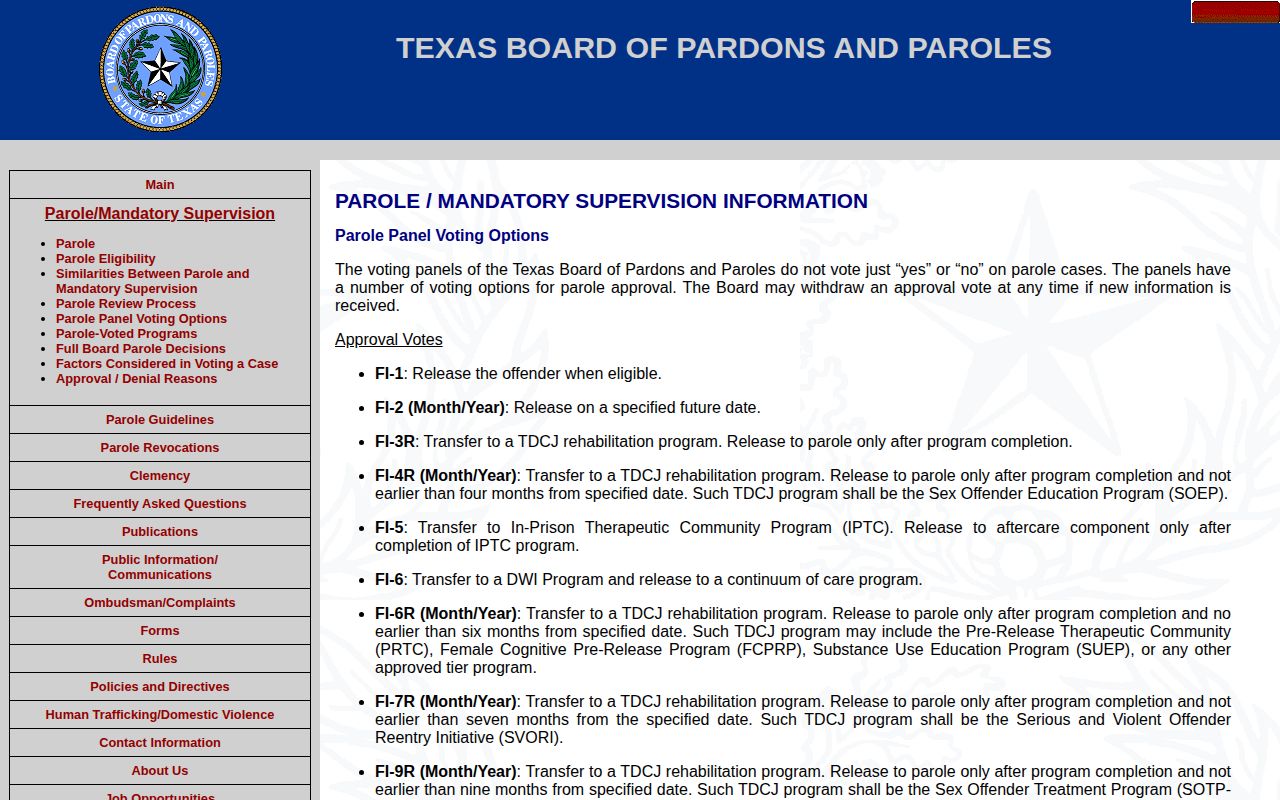
Read the full code and any condition before treating a favorable vote as a release event.
Jim Wells Probation Access
The 79th Judicial District CSCD jointly serves Jim Wells and Brooks Counties. It manages probation as well as pretrial and diversion pathways. The Jim Wells office is in Alice. Its client-access system is not an open public lookup. CSS Reporting requires an access code supplied by the probation officer, which means a member of the public cannot use that login to browse supervision records.
Jim Wells County Probation Office
610 East Second Street
Alice, TX 78332
Phone: 361-664-9199
Use the CSCD office page for current agency details. The CSS client-access page explains the officer-issued code. To verify probation, first obtain the court's signed order and cause number. Then ask CSCD what public confirmation is available. Do not seek a residence address, treatment notes, victim information, or other protected case details.
The official Jim Wells client page makes the access limit visible.
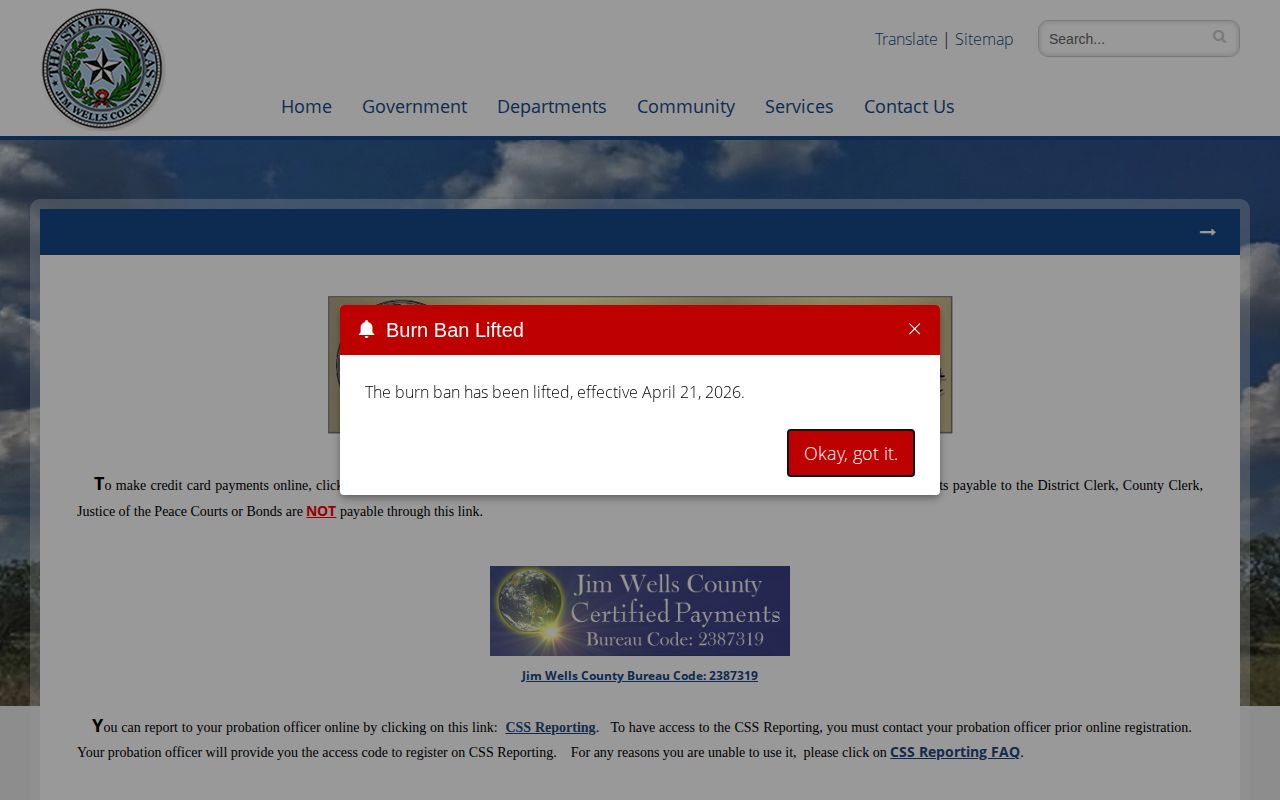
Its controlled sign-in supports using the clerk and CSCD contact route instead of treating CSS as a public people search.
Jim Wells Violations and Warrants
No general official Jim Wells County absconder or active-warrant list was found in the county and sheriff navigation reviewed. The specialized Texas sex-offender absconder information is not a complete parole or probation warrant list. Absence there cannot prove that no warrant exists.
For probation, the public court docket may show a motion to revoke community supervision or a motion to adjudicate. The signed order matters more than a short docket label. An active warrant can be restricted, and a docket may lag. Ask the clerk or CSCD about public status using the cause number.
For parole, an alleged violation may lead to a warrant, detention, and BPP preliminary or revocation procedures. Those proceedings differ from the file-review vote used when parole was first considered. If a person vanishes from the Jim Wells jail roster after a violation arrest, that absence may reflect transfer on a parole warrant. It should not be called release until the destination is confirmed.
Texas IVSS may provide custody or supervision events for TDCJ and participating county feeds. Jim Wells County participation in IVSS-Counties was not established by the reviewed sources, so an alert is a prompt to verify, not a certified supervision record.
Note: A warrant claim needs confirmation from the responsible court or supervision agency, since online lists can be narrow, delayed, or unavailable.
Jim Wells Supervision Discharge
Physical release and discharge occur at different points. A person on parole has left secure TDCJ confinement, but the sentence still runs under conditions. A person on probation remains subject to the trial court's order. Final discharge is the point at which that specific supervision obligation ends.
For TDCJ, request incarceration and supervision history from the agency when the current-only inmate search no longer returns the person. Ask for the actual release date, release mechanism, and supervision-discharge date. For Jim Wells probation, obtain the court order showing successful discharge, early termination, revocation, or other final action. A clerk docket entry can locate the event, but the signed order gives the most reliable terms.
Texas public-record rules do not make every supervision detail public. Government Code Chapter 552 permits a written request, but confidentiality laws and exceptions may require redaction. A custodian should release non-exempt parts and identify the basis for withheld material. Ten business days is not a universal production deadline. If an agency seeks an Attorney General ruling, separate notice deadlines apply.
Jim Wells Reentry Documents
A Southern District of Texas reentry directory for Jim Wells County identifies Alice-area routes for replacing state identification and Social Security documents, along with local support contacts. It is useful as a navigation lead after release, especially when identification is needed to obtain personal records or meet supervision instructions. The directory may be dated, so confirm each office's current hours, eligibility rules, required proof, and appointment process before traveling.
The Jim Wells reentry directory does not establish that a person is on parole or probation. It also does not replace directions from a supervision officer. Use it to locate services, then verify the provider's present details. Supervision questions still go to TDCJ Parole Division or the 79th Judicial District CSCD.